


When utilizing an Activated Alumina Hydrolysis Catalyst Carrier in continuous flow reactors, several crucial considerations must be taken into account to ensure optimal performance, efficiency, and longevity of the catalytic process. As a leading supplier of Activated Alumina Hydrolysis Catalyst Carrier, we understand the intricacies involved in this application and are committed to providing high - quality products that meet the diverse needs of our customers.
Physical Properties
The physical properties of the Activated Alumina Hydrolysis Catalyst Carrier play a fundamental role in its performance within a continuous flow reactor. Surface area is one of the most critical factors. A high surface area provides more active sites for the catalytic reaction to occur. This allows for a greater number of reactant molecules to come into contact with the catalyst, thereby increasing the reaction rate. Our Activated Alumina Hydrolysis Catalyst Carrier is engineered to have a large and well - distributed surface area, which enhances its catalytic efficiency.
Pore size and pore volume also significantly impact the performance. The pore size should be appropriate to accommodate the reactant molecules and allow for their diffusion to the active sites. If the pores are too small, reactant molecules may experience diffusion limitations, reducing the reaction rate. On the other hand, if the pores are too large, the surface area per unit volume may decrease, leading to fewer active sites. Our carrier is designed with a carefully controlled pore size distribution to ensure efficient mass transfer and reaction kinetics.
Particle size and shape are additional physical properties to consider. In a continuous flow reactor, the particle size affects the pressure drop across the reactor bed. Smaller particles can provide a larger surface area but may cause a higher pressure drop, which can increase the energy consumption for pumping the reactants. We offer a range of particle sizes to meet different reactor design requirements, allowing our customers to optimize the balance between surface area and pressure drop.
Chemical Compatibility
Chemical compatibility is of utmost importance when using an Activated Alumina Hydrolysis Catalyst Carrier in a continuous flow reactor. The carrier must be chemically stable in the presence of the reactants, products, and any other substances present in the reaction environment. It should not react with the reactants or products in a way that would deactivate the catalyst or produce unwanted by - products.
For example, in hydrolysis reactions, the carrier should be resistant to the corrosive effects of water and any acidic or basic species that may be generated during the reaction. Our Activated Alumina Hydrolysis Catalyst Carrier has excellent chemical stability, ensuring long - term performance in a variety of hydrolysis reaction conditions.
It is also essential to consider the compatibility with the active catalytic components. The carrier should provide a suitable support for the active species, allowing for strong adhesion and proper dispersion. This ensures that the active sites are accessible to the reactants and that the catalytic activity is maintained over time.
Catalytic Activity and Selectivity
The catalytic activity of the Activated Alumina Hydrolysis Catalyst Carrier is a key consideration. It should have the ability to accelerate the hydrolysis reaction at a reasonable rate under the operating conditions of the continuous flow reactor. The activity is influenced by factors such as the surface area, the nature of the active sites, and the interaction between the carrier and the active catalytic components.
Selectivity is equally important. In many hydrolysis reactions, there may be multiple possible reaction pathways, and the catalyst carrier should promote the desired reaction while minimizing the formation of unwanted by - products. Our carrier is designed to enhance the selectivity of the hydrolysis reaction, ensuring that the desired products are obtained with high purity.
Thermal Stability
Continuous flow reactors often operate at elevated temperatures, and the Activated Alumina Hydrolysis Catalyst Carrier must have good thermal stability. High temperatures can cause structural changes in the carrier, such as sintering or phase transitions, which can reduce the surface area and deactivate the catalyst.
Our carrier is formulated to withstand high temperatures without significant loss of its physical and chemical properties. This thermal stability ensures that the catalyst maintains its activity and selectivity over long periods of operation at elevated temperatures, reducing the need for frequent catalyst replacement.
Mechanical Strength
In a continuous flow reactor, the Activated Alumina Hydrolysis Catalyst Carrier is subjected to mechanical stresses, such as the flow of reactants and the pressure within the reactor. It must have sufficient mechanical strength to resist attrition and breakage. If the carrier particles break or attrite, it can lead to a decrease in the surface area, an increase in the pressure drop, and potential fouling of downstream equipment.

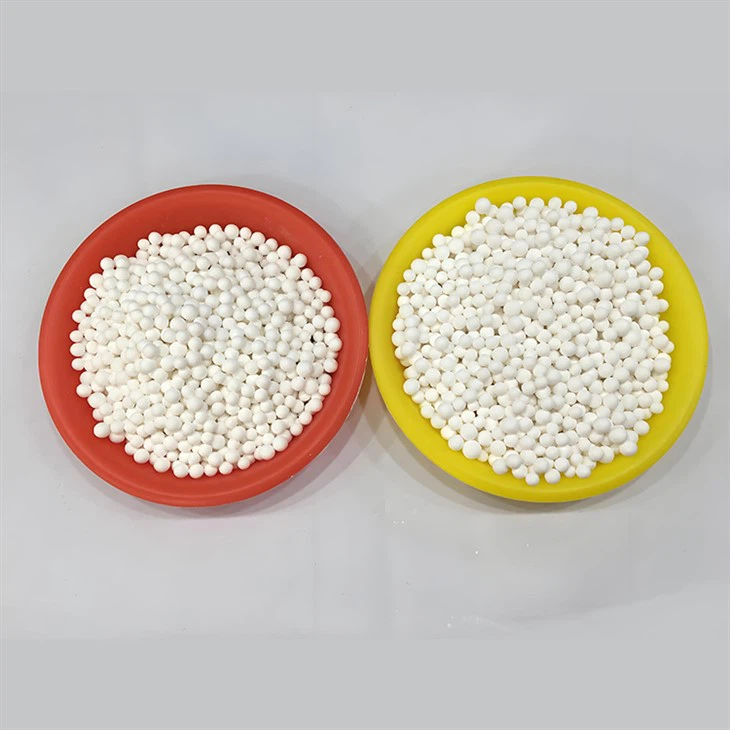
Our carrier is engineered to have high mechanical strength, ensuring its integrity during the operation of the continuous flow reactor. This reduces the maintenance requirements and improves the overall reliability of the catalytic process.
Regenerability
Over time, the Activated Alumina Hydrolysis Catalyst Carrier may become deactivated due to factors such as the deposition of impurities or the loss of active sites. The ability to regenerate the carrier is an important consideration. A regenerable carrier can be reused, reducing the cost of catalyst replacement.
We offer carriers that can be regenerated through appropriate regeneration processes, such as thermal treatment or chemical washing. This allows our customers to extend the lifespan of the catalyst and reduce their operating costs.
Cost - Effectiveness
Cost - effectiveness is a significant consideration for any industrial process. When choosing an Activated Alumina Hydrolysis Catalyst Carrier, it is important to consider not only the initial cost of the carrier but also its long - term performance and maintenance requirements.
Our products are competitively priced, and their high performance, long lifespan, and regenerability make them a cost - effective choice for continuous flow reactor applications. We work closely with our customers to understand their specific needs and provide solutions that offer the best value for money.
Other Related Catalyst Carriers
In addition to our Activated Alumina Hydrolysis Catalyst Carrier, we also offer other high - quality catalyst carriers, such as the Organic Sulfur Hydrogenation Catalyst Carrier, Activated Alumina Dehydrogenation Catalyst Carrier, and Claus Sulfur Recovery Catalyst Carrier. These carriers are designed to meet the specific requirements of different catalytic reactions and offer excellent performance in their respective applications.
Conclusion
When using an Activated Alumina Hydrolysis Catalyst Carrier in continuous flow reactors, a comprehensive understanding of the physical properties, chemical compatibility, catalytic activity, thermal stability, mechanical strength, regenerability, and cost - effectiveness is essential. As a trusted supplier, we are dedicated to providing high - quality carriers that meet the strict requirements of continuous flow reactor applications.
If you are interested in our Activated Alumina Hydrolysis Catalyst Carrier or any of our other catalyst carriers, we invite you to contact us for further information and to discuss your specific needs. Our team of experts is ready to assist you in selecting the most suitable catalyst carrier for your continuous flow reactor application.
References
- Satterfield, C. N. Heterogeneous Catalysis in Industrial Practice. McGraw - Hill, 1991.
- Thomas, J. M., & Thomas, W. J. Principles and Practice of Heterogeneous Catalysis. Wiley, 1997.
- Ertl, G., Knözinger, H., & Weitkamp, J. Handbook of Heterogeneous Catalysis. Wiley - VCH, 1997.


