


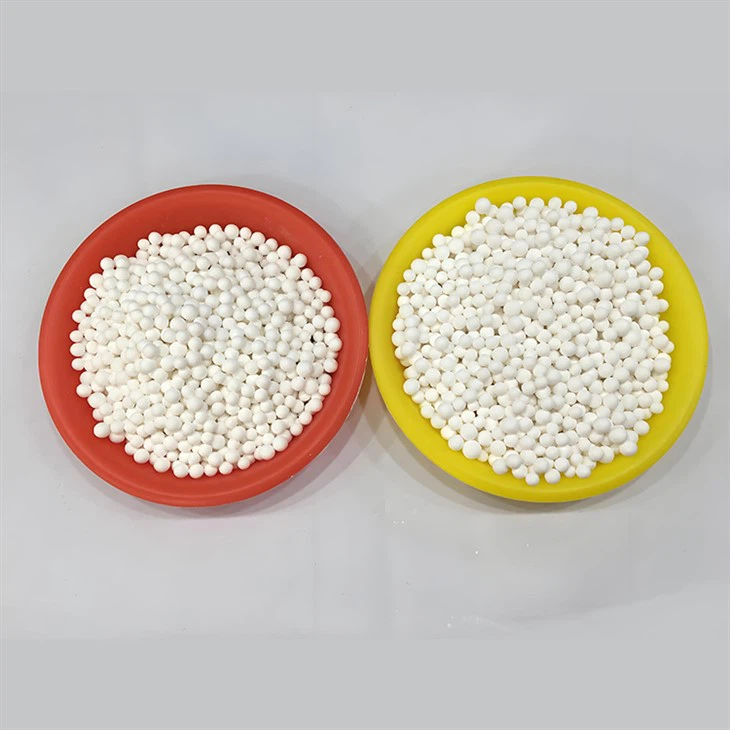


Activated alumina as a carrier of claus sulfur recovery catalysts, achieves efficient elemental sulfur recovery in the treatment of sulfur-containing gases by supporting active components and optimizing catalytic reaction pathways. The specific applications are as follows:
The basis of claus reaction and carrier action
Reaction principle:
The Claus process converts H₂S into elemental sulfur through catalytic reactions, with the main reactions being:
High-temperature thermal reaction: 2H₂S + O₂ → 2H₂O + S₂ (completed in the furnace)
Catalytic reaction: H₂S + SO₂ → 3S + 2H₂O (completed in the catalytic bed), a catalyst is required to promote reaction equilibrium and rate.
Core functions of the carrier:
Activated alumina provides a high specific surface area (> 200 m²/g) and porous structure for active components (such as Al₂O₃ itself or supported additives like TiO₂ and SiO₂), enhancing the adsorption and reaction efficiency of H₂S and SO₂.
Activated alumina can withstand high temperatures (250-400 ℃) and sulfur vapor erosion, with an anti-crushing strength of over 150 N per particle, preventing the catalyst from breaking due to sulfur accumulation or thermal cycling.
Performance optimization of activated alumina carriers
- Hole structure design
It adopts a macroporous (> 50 nm) and mesoporous (2-50 nm) hierarchical structure with a pore volume of > 0.4 cm³/g, which facilitates the diffusion and desorption of sulfur vapor (which condenses into liquid sulfur) and prevents pore blockage.
- Surface chemical regulation:
Moderate alkalinity on the carrier surface (such as introducing a small amount of Na₂O and K₂O) can enhance the adsorption capacity for H₂S and promote the catalytic reaction. If the raw gas contains acidic gases such as CO₂, the alkalinity needs to be controlled to prevent carbonate deposition.
Modification and Application of Composite carriers
- Anti-sulfation modification:
In the high-temperature section (300-400 ℃), activated alumina is prone to react with SO₃ to form aluminium sulfate, leading to deactivation. By adding additives such as TiO₂ and ZrO₂ to form composite carriers (such as Al₂O₃-TiO₂), sulfation can be inhibited and high-temperature stability can be improved.
- Water and heat aging resistance treatment
The water vapor generated in the claus reaction will shrink the pore structure of the activated alumina carrier and decrease the specific surface are. The hydrothermal stability of the carrier can be enhanced by high-temperature calcination (such as above 1000℃) or silicon (Si) modification.
Technical Index
Product name: Claus Sulfur Recovery Catalyst carrier
Chemical Formula: AI2O3
CAS: 1344-28- 1
|
Item analysis |
Unit |
Technical Parameters |
|
|
Al2O3 |
% |
≥93 |
≥93 |
|
SiO2 |
% |
≤0.10 |
≤0.10 |
|
Fe2O3 |
% |
≤0.04 |
≤0.04 |
|
Na2O |
% |
≤0.45 |
≤0.45 |
|
Surface area |
m2/g |
≥200 |
≥300 |
|
Pore volume |
ml/g |
≥0.40 |
≥0.40 |
|
Bulk density |
g/ml |
≥0.60 |
≥0.60 |
|
Crushing strength |
N/Granule |
≥100(4-6mm) |
≥120 (4-6mm) |
Typical Application Scenarios And Processes
Natural gas and desulfurization in oil refineries
Treating acid gas after natural gas desulfurization (with H₂S content ranging from 10% to 90%), flue gas from catalytic cracking regeneration in oil refineries.
The process: The acid gas is partially oxidized in the combustion furnace to form SO₂, which, together with the remaining H₂S, enters the reactor filled with activated alumina carrier catalyst. Under the catalytic reaction at 250-320 ℃, elemental sulfur is generated, with a sulfur recovery rate of up to 95% - 99%.
Treatment of acidic gas in coal chemical industry
The acidic gases (containing H₂S and CO₂) produced from coal-to-hydrogen and coal-to-methanol processes are treated by the Klaus unit. The activated alumina carrier catalyst can efficiently convert H₂S under the coexistence of CO₂, reducing sulfur emissions.
Comparative Advantages Over Other Carriers
Cost lower than TiO₂ carrier
Activated alumina is low in price and its catalytic activity is close to TiO₂ in the medium and low temperature range (< 300℃), making it suitable for most industrial scenarios.
The sulfur capacity is higher than that of silica gel carriers
The pore structure of activated alumina is more suitable for the condensation and storage of sulfur vapor, with a higher sulfur holding capacity per unit volume of the catalyst and a reduced regeneration frequency.
Catalyst Deactivation And Regeneration
Cause of inactivation: High-temperature sulfation, carbon deposits or mechanical impurities clog the channels,The active sites on the surface of activated alumina are covered.
Regeneration method: Inert gas (N₂) purge is used to remove accumulated sulfur, or regeneration is carried out in a reducing atmosphere (H₂/N₂) to restore the pore structure and active sites of the carrier.
Summary
Activated alumina, as the carrier of Claus sulfur recovery catalyst carrier, achieves efficient sulfur recovery in sulfur-containing gas treatment through pore structure hierarchical design, sulfate-resistant modification and surface chemical regulation. Its core value lies in:
- Adapt to the mass transfer requirements of H₂S/SO₂ catalytic reactions;
-The ability to resist water heat and sulfation ensures long-term operation.
-Low cost and mature process make it the mainstream carrier material for sulfur recovery in the petroleum, natural gas and coal chemical industries.
Hot Tags: claus sulfur recovery catalyst carrier, China claus sulfur recovery catalyst carrier manufacturers, suppliers, factory, Claus Sulfur Recovery Catalyst Carrier, activated alumina, Potassium Permanganate Alumina Adsorbent Ball, CO MO System Sulfur tolerant Shift Catalyst Carrier, Organic Sulfur Hydrogenation Catalyst Carrier, Activated Alumina Hydrolysis Catalyst Carrier


