


The industrial revolution has propelled significant economic growth and technological advancements. However, it has also brought about a substantial increase in industrial waste gas emissions, which pose a severe threat to the environment and human health. Among the various methods proposed for treating industrial waste gas, the use of catalysts and adsorbents is a promising approach. In this blog post, I will discuss the role of Titanium Modified Activated Alumina in the treatment of industrial waste gas, drawing on my experience as a supplier of this material.
Understanding Industrial Waste Gas
Industrial waste gas is a complex mixture of pollutants, including sulfur oxides (SOx), nitrogen oxides (NOx), volatile organic compounds (VOCs), and particulate matter. These pollutants are released into the atmosphere from various industrial processes such as power generation, chemical manufacturing, petroleum refining, and metal smelting. The emissions of these pollutants have numerous adverse effects, such as air pollution, acid rain, global warming, and respiratory diseases in humans.
The Need for Effective Waste Gas Treatment
The legislative requirements and growing environmental awareness have made it essential for industries to adopt effective waste gas treatment technologies. These technologies aim to reduce the concentration of pollutants in the waste gas before it is released into the environment. The choice of treatment technology depends on several factors, including the type and concentration of pollutants, the volume of waste gas, and the cost of treatment.
What is Titanium Modified Activated Alumina?
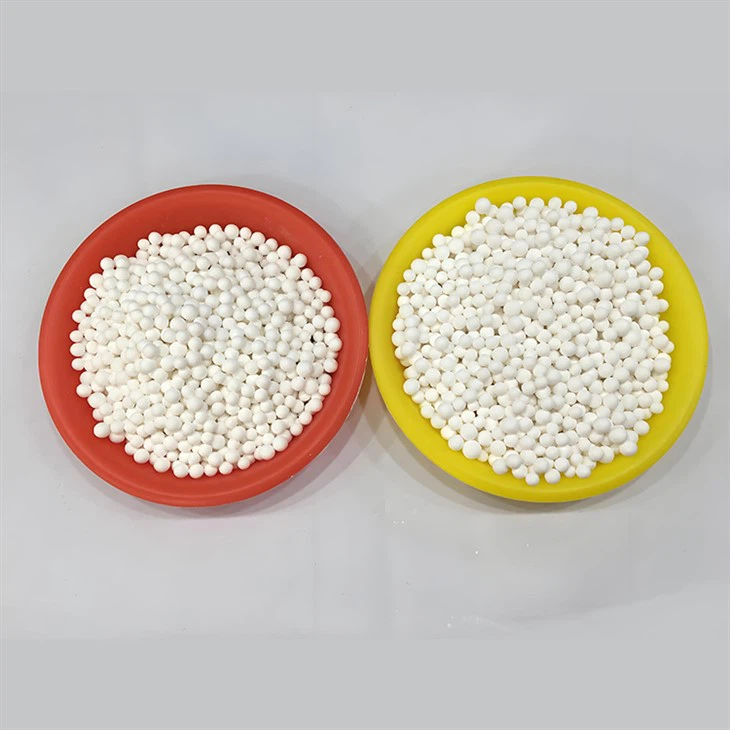
Titanium Modified Activated Alumina is an advanced form of activated alumina that has been modified with titanium. Activated alumina is a porous, solid material with a high surface area, which makes it an excellent adsorbent and catalyst support. The addition of titanium enhances its catalytic activity, adsorption capacity, and thermal stability. It can be used in various forms, such as spheres, tablets, and extrudates, depending on the application.
Adsorption Properties of Titanium Modified Activated Alumina
One of the primary roles of Titanium Modified Activated Alumina in industrial waste gas treatment is adsorption. It can adsorb a wide range of pollutants, including SOx, NOx, and VOCs, through physical and chemical processes. The high surface area and porous structure of the material provide a large number of adsorption sites, allowing it to capture pollutants effectively.
For instance, in the case of SOx removal, Titanium Modified Activated Alumina can adsorb sulfur dioxide (SO₂) through a chemisorption process. The SO₂ molecules react with the surface hydroxyl groups of the alumina to form sulfate species, which are then retained on the surface of the material. This process is highly effective in reducing the concentration of SO₂ in the waste gas.
Catalytic Properties of Titanium Modified Activated Alumina
In addition to its adsorption properties, Titanium Modified Activated Alumina also exhibits excellent catalytic activity. It can act as a catalyst or a catalyst support in various reactions involved in waste gas treatment. For example, it can be used in the selective catalytic reduction (SCR) of NOx, where ammonia (NH₃) is used as a reducing agent to convert NOx into nitrogen (N₂) and water (H₂O). The presence of titanium in the modified alumina enhances the catalytic activity and selectivity of the SCR reaction, leading to a higher conversion of NOx.
Another important application of Titanium Modified Activated Alumina is in the oxidation of VOCs. It can catalyze the oxidation of VOCs to carbon dioxide (CO₂) and water at relatively low temperatures, which is energy-efficient and environmentally friendly. The catalytic activity of the material is attributed to the presence of titanium species on its surface, which can activate oxygen molecules and promote the oxidation reaction.
Applications in Specific Industrial Processes
Titanium Modified Activated Alumina finds extensive applications in various industrial processes for waste gas treatment.
Petroleum Refining: In the petroleum refining industry, waste gas contains a significant amount of sulfur compounds, such as hydrogen sulfide (H₂S) and mercaptans. Titanium Modified Activated Alumina can be used as a catalyst carrier for the hydrogenation of organic sulfur compounds. Organic Sulfur Hydrogenation Catalyst Carrier based on this material can effectively convert organic sulfur compounds into H₂S, which can then be removed by other processes.
Sulfur Recovery Units: In the sulfur recovery process, the Claus process is widely used to convert H₂S into elemental sulfur. Titanium Modified Activated Alumina can serve as a Claus Sulfur Recovery Catalyst Carrier, enhancing the catalytic activity and selectivity of the Claus reaction. This helps to improve the sulfur recovery efficiency and reduce the environmental impact of sulfur emissions.
Chemical Manufacturing: In chemical manufacturing plants, waste gas often contains various VOCs and other pollutants. Titanium Modified Activated Alumina can be used in the adsorption and oxidation of these pollutants, ensuring compliance with environmental regulations.

Advantages of Using Titanium Modified Activated Alumina
There are several advantages of using Titanium Modified Activated Alumina in industrial waste gas treatment:
- High Efficiency: It has a high adsorption capacity and catalytic activity, which allows for the effective removal of pollutants from industrial waste gas.
- Thermal Stability: The material exhibits good thermal stability, which enables it to withstand high temperatures during the treatment process without significant loss of activity.
- Regenerability: Titanium Modified Activated Alumina can be regenerated after use, which reduces the operating cost and waste generation.
- Versatility: It can be used for the removal of a wide range of pollutants, making it suitable for various industrial applications.
Our Offerings as a Supplier
As a supplier of Titanium Modified Activated Alumina, we are committed to providing high-quality products and excellent customer service. Our Titanium Modified Activated Alumina is produced using advanced manufacturing processes and strict quality control measures to ensure its performance and reliability.
We offer a variety of product specifications to meet the different needs of our customers. Whether you need a specific particle size, shape, or catalytic activity, we can customize the product according to your requirements. In addition, we provide technical support and after-sales service to help you optimize the use of our product in your waste gas treatment system.
Request for Contact and Purchase
If you are an industrial enterprise looking for an effective solution for waste gas treatment, we invite you to contact us for more information about our Titanium Modified Activated Alumina. Our team of experts will be happy to discuss your specific needs and provide you with a tailored solution. We believe that our product can help you meet the environmental regulations and improve the sustainability of your operations. So, don't hesitate to get in touch with us for purchase negotiations.
References
- Jaeger, C. (2006). Air Pollution Control: A Design Approach. CRC Press.
- Yang, R. T. (2012). Gas Separation by Adsorption Processes. World Scientific.
- Bartholomew, C. H., & Farrauto, R. J. (2006). Fundamentals of Industrial Catalytic Processes. John Wiley & Sons.


