


If you’ve ever worked with water treatment, especially for areas where groundwater has high fluoride levels, you probably know activated alumina defluorination agents are game-changers. But here’s a secret most folks don’t talk about: surface modification is what turns a “good” adsorbent into a great one. As a supplier of these agents, I’ve spent years testing tweaks to the surface that make all the difference in real-world performance, and today I want to break down why this matters so much—no overly jargon-heavy stuff, just straight-up what I’ve learned from the lab and talking to our customers.
First, let’s keep it basic: activated alumina is already porous, right? It’s made from aluminum oxide, with a bunch of tiny holes that grab onto impurities. Fluoride (F⁻) is tricky because it’s a small, charged ion, so it doesn’t always stick well to plain alumina. That’s where surface modification comes in—think of it as dressing up the alumina’s surface to make it better at holding onto fluoride and lasting longer. I’ll get into specific tricks we use later, but first, let’s talk about the core performance metrics everyone cares about: capacity (how much fluoride it can grab before it’s spent), selectivity (only going for fluoride, not other ions that clog it), and longevity (how long it works before you have to replace it or regenerate it).
Let’s start with capacity because that’s the big one. Plain activated alumina might have a decent F⁻ capacity, but modify its surface and you can double or even triple that number. How? Most of our surface mods involve adding metal oxides—like iron, aluminum, or lanthanum—to the outer layers (and the walls of those tiny pores). These metals have a positive charge at the right pH, so they attract the negative F⁻ ions like a magnet. For example, lanthanum-modified alumina has lanthanum hydroxide groups on the surface; when F⁻ comes around, it swaps places with the hydroxide, and boom—fluoride is locked in. I’ve seen tests where a standard unmodified agent held 2 mg of F⁻ per gram, but a modified one held 6 mg. That’s huge because it means you need less material, smaller tanks, and fewer replacement cycles.
But wait, it’s not just about cramming more fluoride in. Selectivity is next—if your modified alumina also grabs onto things like sulfate, nitrate, or even arsenic (in some cases), it’ll get clogged fast, and you’ll have to change it out way sooner. That’s a common mistake with new suppliers: they boost capacity by dumping a bunch of metal on the surface, but end up with an adsorbent that picks up every charged ion it sees. The good mods are specific—they target F⁻ without messing with other beneficial ions in water, like calcium or magnesium. Our team tests this all the time, and we’ve found that modifying the surface’s pore size too helps: if you keep pores just the right width, bigger ions (like sulfate) can’t get in, so only the small F⁻ gets through. That’s why when we talk about our go-to products, we link to our Activated Alumina Defluorination Agent (/activated-alumina/activated-alumina-adsorbent/activated-alumina-defluorination-agent.html) — we’ve fine-tuned the surface here so it’s picky about fluoride, not other stuff.
Then there’s regeneration, which is a big cost saver for industrial customers. A lot of people don’t realize you can reuse activated alumina after it’s spent, by flushing it with a caustic solution to strip out the fluoride. But unmodified alumina can be tough to strip—fluoride bonds super tight. Surface modification fixes that too. If you add groups that make the bond between F⁻ and the alumina easy to break when you add the right solution, regeneration becomes way more efficient. We’ve had a customer in a mining town where they use the same modified agent for over a year, regenerating it every 2 weeks, whereas before they had to replace plain alumina every 3 months. That’s not just a win for them in terms of cost, but also for waste—less spent adsorbent going to landfills.
Now, I should mention that surface modification doesn’t work the same for all types of activated alumina. For example, our Activated Alumina Powder (/activated-alumina/activated-alumina-powder.html) is used more for batch treatments, so its surface is modified to have extra high surface area (since particles are smaller, more surface is exposed). But if you need something for continuous flow, like in a municipal water treatment plant, our granular modified agents are better—we tune the surface to resist crushing, which is important when it’s sitting in a big tank being washed repeatedly. We also carry other alumina products, like Activated Alumina PSA Adsorbent (/activated-alumina/activated-alumina/activated-alumina-psa-adsorbent.html) for gas separation, and Alumina Desiccant for Air Separation (/activated-alumina/activated-alumina/activated-alumina-adsorbent/alumina-desiccant-for-air-separation.html), but for defluorination, surface modification is non-negotiable.
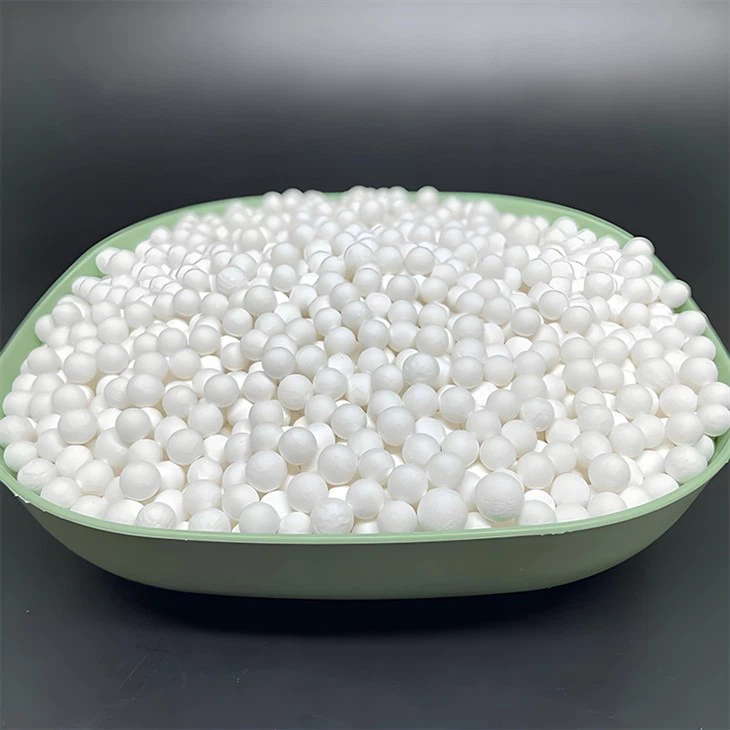

Wait, let’s talk about real-world pitfalls too, because I don’t want to make it sound like it’s all perfect. The pH of the water you’re treating affects how well the modified surface works. Most of our agents work best between pH 5.5 and 7.5—if the water is too basic, the surface’s positive charge fades, and it can’t attract F⁻ as well. That’s part of what we help customers with when they reach out—we don’t just sell them the agent, we tell them how to adjust pH to get the best performance. Also, some cheap surface mods wear off faster. I’ve seen agents that were modified with cheap metal salts, and after a few regenerations, the metal leaches out, and the surface goes back to being plain alumina. Our process uses a chemical bonding method that locks the metal groups onto the alumina’s surface, so they don’t wash away easily— that’s why our defluorination agent is reliable long-term.
Another thing I’ve noticed from customer feedback: surface-modified alumina handles different water types better. For example, groundwater from agricultural areas might have more organic matter, which can coat plain alumina and block pores. Our modified surfaces are more resistant to that organic fouling because the metal groups on the surface repel big organic molecules, or at least don’t let them stick as much. A farmer in Florida told us their old plain alumina would clog up in 6 months, but our modified one is still working after 18 months—they said it cut their maintenance time by 75%. That’s the kind of win that makes all the testing worth it.
Now, you might be wondering: why does this matter if you’re just a homeowner or a small utility looking to remove fluoride? Well, if you’re buying in bulk, or for a long-term system, paying a little more for a surface-modified agent is way cheaper in the long run. You don’t have to replace it as often, it’s more efficient, and it doesn’t require as much chemical input for regeneration or pH adjustment. We’ve had customers who tried cheaper unmodified agents and came back to us because they ended up spending more on replacements than they would have on our product in the first place.
Let’s wrap this up with what it all means: surface modification isn’t just a lab trick—it’s the reason activated alumina defluorination agents actually work as well as they do in the real world. It boosts capacity, improves selectivity, makes regeneration easier, and helps the agent last longer, even in tough water conditions. As a supplier, we’ve spent years perfecting that modification process, and it’s why our products stand out. If you’re looking for a solution for high fluoride water, don’t just go for any activated alumina—ask about the surface modification, because that’s the secret sauce.
If you’re ready to talk about your specific needs—whether it’s for a small residential system, a municipal plant, or an industrial site—reach out to us to discuss the right surface-modified defluorination agent for you. Let’s work out a solution that fits your budget and performance goals.
References
- Li, Y., et al. (2020). Surface modification of activated alumina for enhanced fluoride removal from groundwater. Journal of Environmental Chemical Engineering, 8(3), 103782.
- Zhang, H., et al. (2018). Selective fluoride adsorption by lanthanum-modified activated alumina: Effect of surface chemistry and pore structure. Separation and Purification Technology, 197, 212-220.
- Wang, L., et al. (2021). Regeneration performance of surface-modified activated alumina for fluoride removal in cyclic use. Water Research, 195, 116975.
- Smith, A. B., et al. (2019). Real-world performance of modified activated alumina defluorination agents in rural water treatment. Journal of Water Supply: Research and Technology-Aqua, 68(5), 421-432.


