


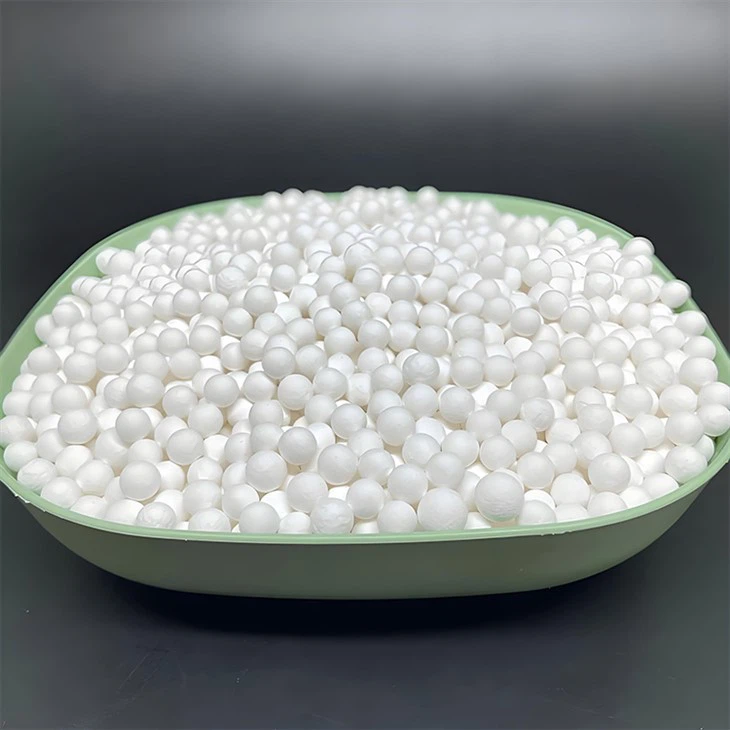


Under certain operating and regeneration conditions, the drying depth of Alumina desiccant for air separation is up to -50 degrees below the dew point temperature. Activated Alumina can be used for drying the air of automatic instruments in the electronics industry and as a desiccant and purifying agent in the fertilizer, steel, petrochemical and other industries. Activated Alumina is a highly efficient desiccant for deep drying of trace water and is very suitable for non-thermal and micro-thermal regeneration devices.
Activated alumina, as an air separation desiccant, mainly utilizes its high specific surface area, porous structure and strong water absorption characteristics to remove moisture in air separation units, ensuring the stable operation of low-temperature distillation systems. The Activated alumina specific applications are as follows:
The core demand of Activated alumina for desiccants in air separation
- Deep dehydration
The air needs to be dehydrated to a dew point of less than -60℃ (with a water content of less than 1ppm) to prevent water from freezing and blocking pipes or trays at low temperatures (below -170℃).
- Withstand alternating loads
Air separation units mostly adopt pressure swing adsorption (PSA) or temperature swing adsorption (TSA) cycles. The desiccant needs to withstand frequent adsorption and regeneration heat cycles (regeneration temperature 150-250 ℃) to maintain structural stability.
The drying performance advantages of activated alumina
- Physical properties
The specific surface area of activated alumina is greater than 300 m²/g, the pore volume is greater than 0.35 cm³/g, the pore size is concentrated in 2-5 nm, and the water vapor adsorption capacity can reach 15% - 20% of its own weight (at 25℃ and RH=60%).
- Chemical stability
Activated alumina does not react with O₂, N₂, CO₂ and other substances in the air, has strong acid and alkali resistance, is not prone to powdering in a humid environment, and has an anti-crushing strength of over 140 N per particle.
Drying Process and Application Scenarios
- Typical process (TSA process) :
Adsorption stage: Normal-temperature air passes through the alumina bed layer, and moisture is adsorbed. The dew point at the outlet is less than -60℃.
Regeneration stage: Use hot nitrogen at 150-200 ℃ for reverse purging, desorb and discharge the moisture, and restore the activity of the desiccant.
Technical Index
Chemical Formula : AI2O3
CAS No.: 1344-28- 1
|
Item analysis |
Unit |
Technical Parameters |
|||
|
Al2O3 |
% |
≥92 |
≥92 |
≥92 |
≥92 |
|
SiO2 |
% |
≤0.10 |
≤0.10 |
≤0.10 |
≤0.10 |
|
Fe2O3 |
% |
≤0.04 |
≤0.04 |
≤0.04 |
≤0.04 |
|
Na2O |
% |
≤0.045 |
≤0.045 |
≤0.045 |
≤0.045 |
|
Static adsorption |
wt% |
18±1 |
18±1 |
18±1 |
18±1 |
|
Water adsorption |
% |
≥50 |
≥50 |
≥50 |
≥50 |
|
Surface area |
m2/g |
≥300 |
≥300 |
≥300 |
≥280 |
|
Pore volume |
ml/g |
≥0.40 |
≥0.40 |
≥0.40 |
≥0.40 |
|
Loose density |
g/ml |
≤0.72 |
≤0.72 |
≤0.70 |
≤0.70 |
|
Crushing strength |
N/Granule |
≥150(3-5mm) |
≥180 (4-6mm) |
≥220 (5-7mm) |
≥240 (6-8mm) |
The key to its application lies in:
①Optimize the pore structure to match the kinetics of water vapor adsorption;
②Enhance the resistance to hydrothermal aging through modification;
③It works in conjunction with materials such as molecular sieves to achieve deep dehydration and cost balance, and is widely used in the field of industrial gas preparation.
Application Scenarios
- Large-scale air separation units: Oxygen preparation in the steel and chemical industries (such as those with a scale of over 10,000 Nm³/h), with alumina desiccants filled in the adsorption tower, and the two towers operating alternately to ensure continuous gas supply.
- Small PSA nitrogen generator: Nitrogen used in food packaging and pharmaceutical industries, alumina and molecular sieves (such as 13X) are used in combination. The former is used for pretreatment and dehydration, while the latter deeply removes impurities such as CO₂.
Comparison with other desiccants
Superior to silicone:
Activated alumina has a higher adsorption capacity at high temperatures (> 100℃), improved regeneration efficiency, and strong resistance to water vaporization shock, making it less likely to break due to sudden temperature changes.
- Cost lower than that of molecular sieves
Under the same adsorption capacity, the price of alumina is approximately 1/3 to 1/2 of that of 13X molecular sieve. It is suitable for large-scale dehydration in the pretreatment stage, while molecular sieve is used for deep drying or removal of other impurities.
Modification and Performance Optimization
Regulation of surface hydroxyl groups
More surface hydroxyl groups (-OH) are retained through low-temperature calcination (< 500℃), enhancing the chemical adsorption capacity for water molecules.
- Preparation of composite desiccant:
Activated alumina can be mixed and pressed with a small amount of molecular sieve powder or surface-loaded with hygroscopic salts such as LiCl to enhance the moisture absorption efficiency in low-temperature (< 5℃) environments, making it suitable for air separation units in humid areas.
Failure and regeneration maintenance
Failure characterization:
The dew point at the outlet after adsorption is ≥-40℃, or the pressure drop of the bed layer increases significantly (due to pulverization blockage).
Regeneration method:
High-temperature inert gas purging (200-250℃) for 4-6 hours, can be reused 5-10 times; If the powdering is severe, it needs to be replaced.
Summary
Alumina desiccant for air separation , has become the core material for pre-treatment dehydration in air separation units due to its high specific surface area, high-temperature resistance to regeneration and cost advantages.
Hot Tags: alumina desiccant for air separation, China alumina desiccant for air separation manufacturers, suppliers, factory, Activated Alumina Balls for Hydrogen Peroxide, Activated Alumina Defluorination Agent, Alumina Adsorbent for Liquid Crystal, Alumina Desiccant for Air Separation, Activated Alumina PSA Adsorbent, Activated Alumina Powder


