


Hey there! I'm an activated alumina defluorination agent supplier, and today I wanna chat about the adsorption kinetics of our activated alumina defluorination agent for fluoride. It's a pretty cool topic, and understanding it can really make a difference when it comes to choosing the right product for your needs.
What is Adsorption Kinetics?
First off, let's talk about what adsorption kinetics means. Simply put, it's all about how fast and how well a substance (in this case, our activated alumina defluorination agent) can attract and hold onto another substance (fluoride). There are two main aspects we need to consider: the rate at which the adsorption happens (that's the kinetics part) and the amount of fluoride that the activated alumina can actually adsorb.
The adsorption process is like a little dance between the activated alumina and the fluoride ions in water. The activated alumina has these tiny pores and surface sites that act like little magnets for the fluoride ions. When the fluoride ions come into contact with the activated alumina, they stick to these sites. But how quickly they stick and how many can stick is what the adsorption kinetics is all about.
How Does Activated Alumina Work for Defluorination?
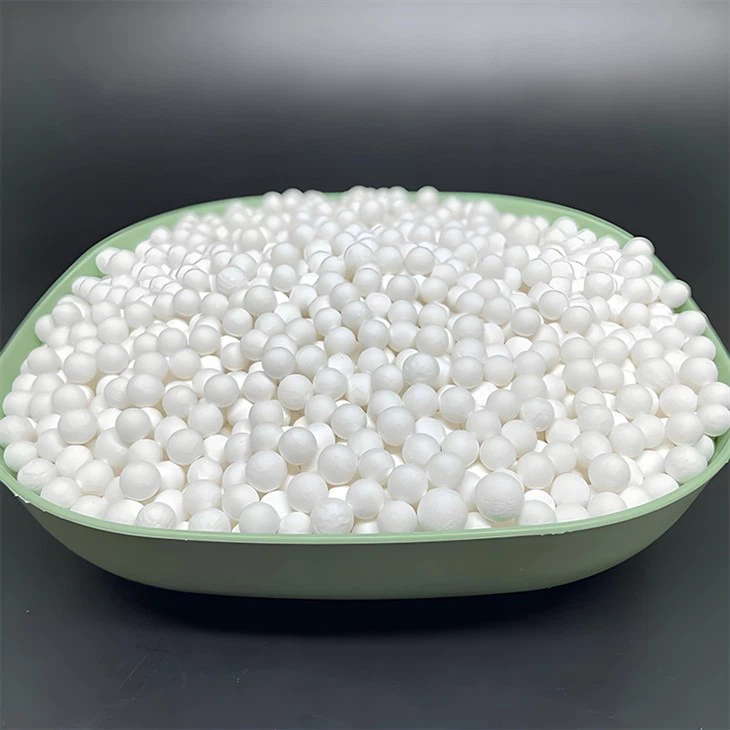
Our activated alumina defluorination agent is made from a special type of aluminum oxide that has been processed to have a high surface area and lots of pores. These pores are super important because they give the fluoride ions more places to attach. When water containing fluoride passes through a bed of our activated alumina, the fluoride ions are attracted to the surface of the alumina and get trapped there.
The adsorption of fluoride onto activated alumina is an ion - exchange process. The activated alumina has hydroxyl groups on its surface. These hydroxyl groups can be exchanged with fluoride ions in the water. So, as the fluoride ions replace the hydroxyl groups, they get adsorbed onto the activated alumina.
Factors Affecting Adsorption Kinetics
There are several factors that can affect the adsorption kinetics of our activated alumina defluorination agent for fluoride.
1. Temperature
Temperature plays a big role. Generally, as the temperature goes up, the adsorption rate also increases. This is because higher temperatures give the fluoride ions more energy to move around and reach the adsorption sites on the activated alumina more quickly. But it's not always a straightforward relationship. Sometimes, if the temperature gets too high, it can actually cause the adsorbed fluoride to desorb (come off) the activated alumina.
2. pH of the Water
The pH of the water is crucial. Our activated alumina works best in a certain pH range. When the pH is around 5 - 6, the adsorption of fluoride is at its peak. If the pH is too high or too low, the surface charge of the activated alumina changes, which can reduce its ability to attract fluoride ions. For example, at high pH values, there are more hydroxide ions in the water, and these can compete with the fluoride ions for the adsorption sites on the activated alumina.
3. Initial Fluoride Concentration
The more fluoride there is in the water to start with, the faster the initial adsorption rate. But there's a limit. Eventually, the activated alumina will reach its maximum adsorption capacity, and adding more fluoride won't increase the amount that gets adsorbed.

4. Contact Time
The longer the water is in contact with the activated alumina, the more fluoride can be adsorbed. This is why in water treatment systems, we often design the process to have a sufficient contact time between the water and the activated alumina.
Measuring Adsorption Kinetics
To figure out the adsorption kinetics of our activated alumina defluorination agent, we use a few different methods. One common way is to do batch experiments. In a batch experiment, we take a certain amount of our activated alumina and mix it with a known volume of water containing fluoride. Then we measure the fluoride concentration in the water at different time intervals.
We can plot the data we get from these experiments on a graph. The graph usually shows how the fluoride concentration in the water decreases over time as it gets adsorbed onto the activated alumina. From this graph, we can calculate things like the adsorption rate constant and the equilibrium adsorption capacity.
Why Our Activated Alumina is a Great Choice
As a supplier, I can tell you that our activated alumina defluorination agent has some great advantages when it comes to adsorption kinetics. We've optimized the production process to make sure that our activated alumina has a large surface area and the right pore size distribution. This means that it can adsorb fluoride quickly and efficiently.
We also offer different types of activated alumina products to suit different needs. For example, if you're interested in other applications related to adsorption, we have Activated Alumina Balls for Hydrogen Peroxide, Activated Alumina PSA Adsorbent, and Alumina Desiccant for Air Separation.
Contact Us for Your Needs
If you're in the market for an activated alumina defluorination agent or any of our other products, I'd love to hear from you. Whether you have a small - scale water treatment project or a large industrial application, we can work with you to find the right solution. Understanding the adsorption kinetics of our product is just the first step. We can provide you with detailed information, samples, and technical support to help you make the best decision.
References
- Foo, K. Y., & Hameed, B. H. (2010). Insights into the modeling of adsorption isotherm systems. Chemical Engineering Journal, 156(1), 2 - 10.
- Gupta, V. K., Suhas, & Ali, I. (2011). Application of low - cost adsorbents for dye removal – A review. Journal of Environmental Management, 92(6), 2313 - 2342.
- Huang, X., & Pan, B. (2015). Fluoride removal from water by adsorption: A review. Journal of Environmental Sciences, 27, 1 - 13.


